USABILITY TESTING | CLIENT PLATFORMS
Scope: Test Duration: 1 month Role: UX Researcher/Designer Platform: UBS Client Website Methodology: Usability Test
Overview:
This project is an example of one of my primary responsibilities at UBS, usability testing. In July 2022 as our team was growing, I built the practice as one of our core competencies. It is now a heavily relied upon function for product owners and is a critical tool to inform product decisions.
My teams hosts all of our usability tests on UserZoom, a research tool that allows us to connect our Figma prototypes to a live study, record users’ screens as they complete our structured tasks, survey users post task, and analyze click paths and interaction maps.
To date I’ve led 15 usability tests across client platforms (UBS website and mobile app) and have directly influenced 19 specific feature releases.
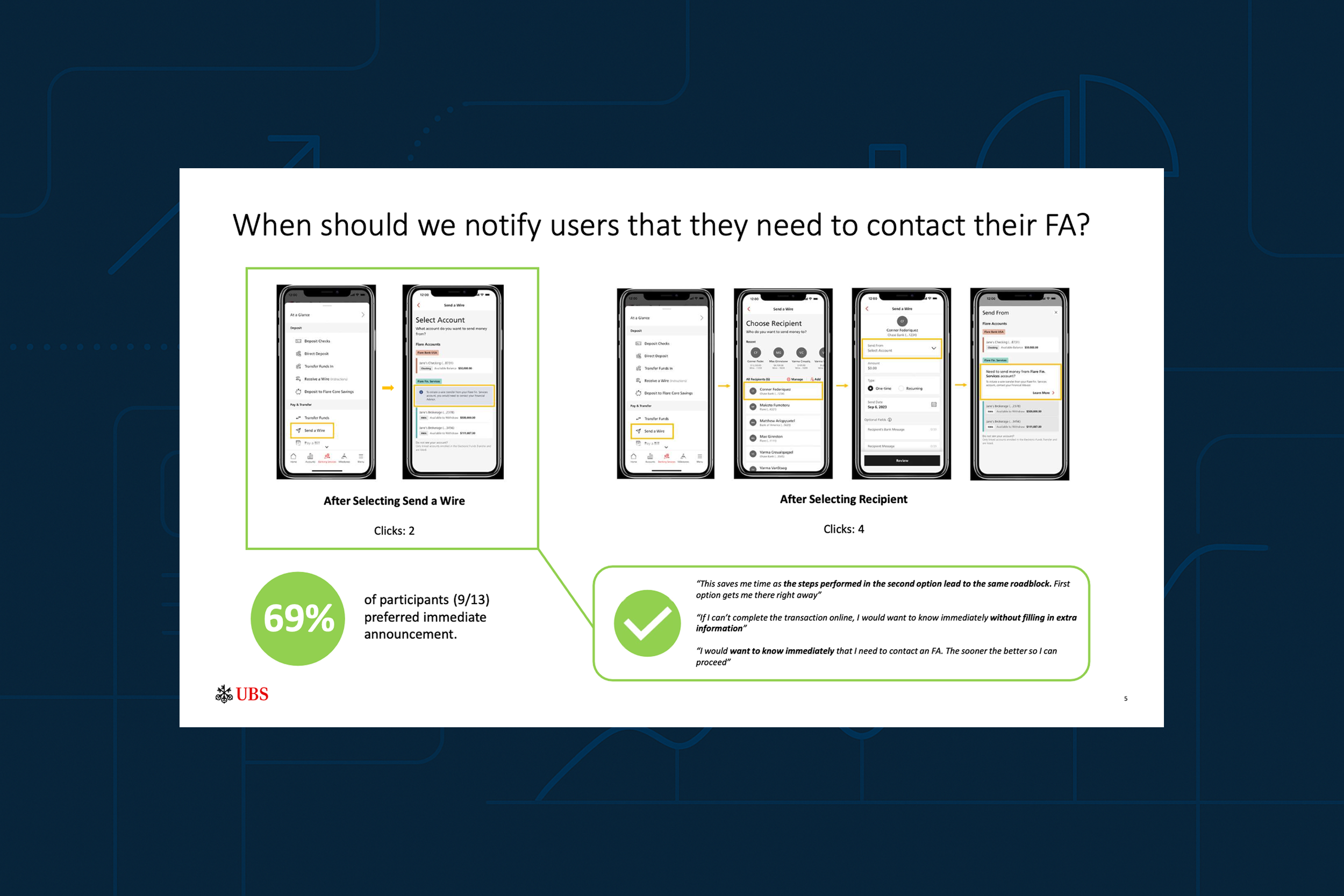
Below is an example of a usability test I led for our money movement experience, specifically assessing 2 new designs for mobile wire transfer.
Objectives:
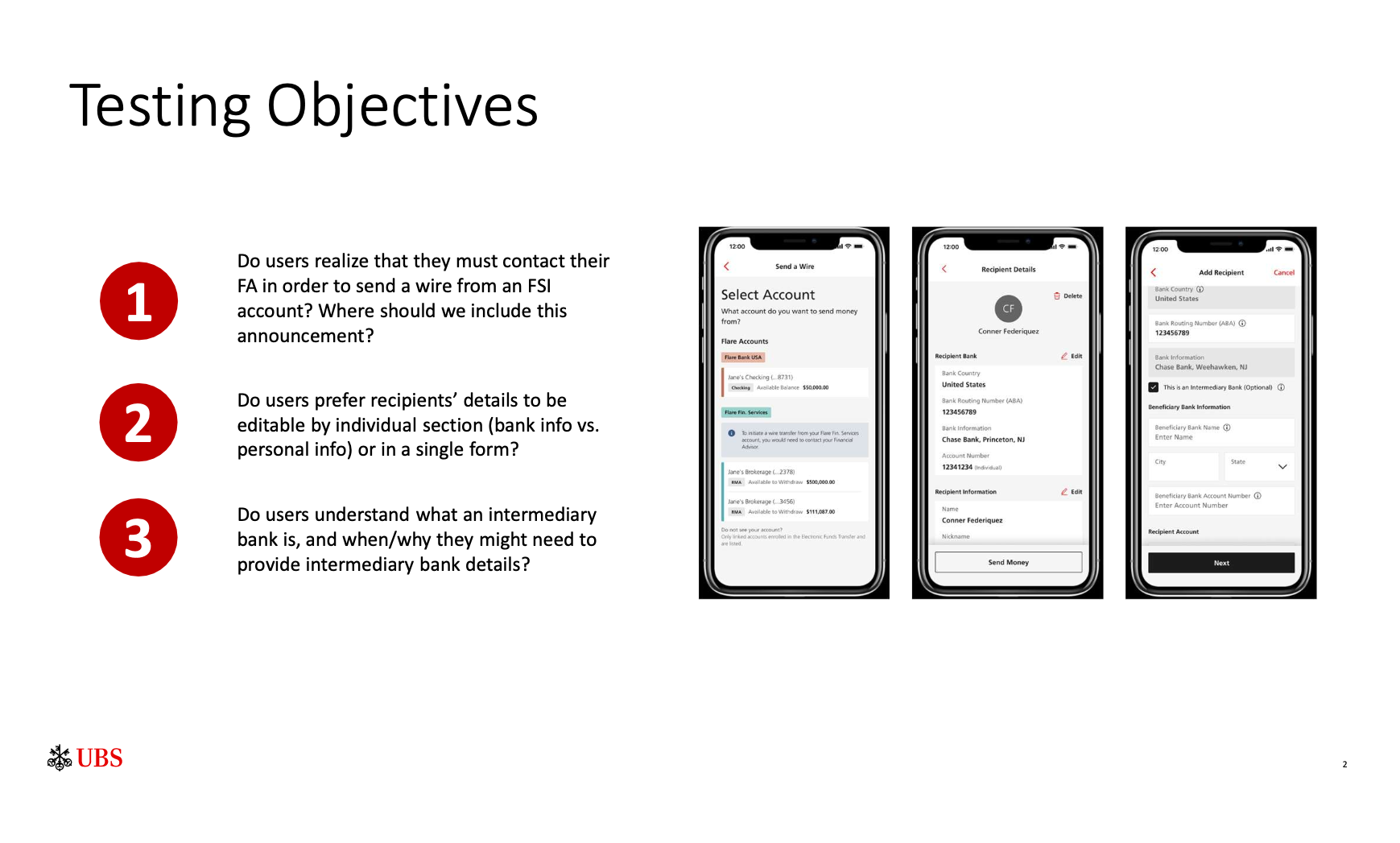
Our money-movement pod approached me with 2 new designs for our mobile wire transfer experience and a few outstanding questions:
Which of the experiences is more user-friendly and why?
For isolated variables like recipient editing mechanics, mid-transfer announcements (FA requirements), and terminology, do clients understand how to use/interact with them?
What changes do we need to make in order to make the experience usable, such that clients can successfully complete a wire transfer?
Outcomes:
Uncovered key changes to make to wire transfer experience features such as:
Font weight to make announcements visible
Changing CTA language to explicit actionability (Learn More -> Initiate a Transfer)
Multiple entry points to instruction list
Copy refinement on wire instructions
Removing toggle between send and receive, which breaks experience
Structure:
I designed a test to put 15 users through the same wire-transfer experience twice,
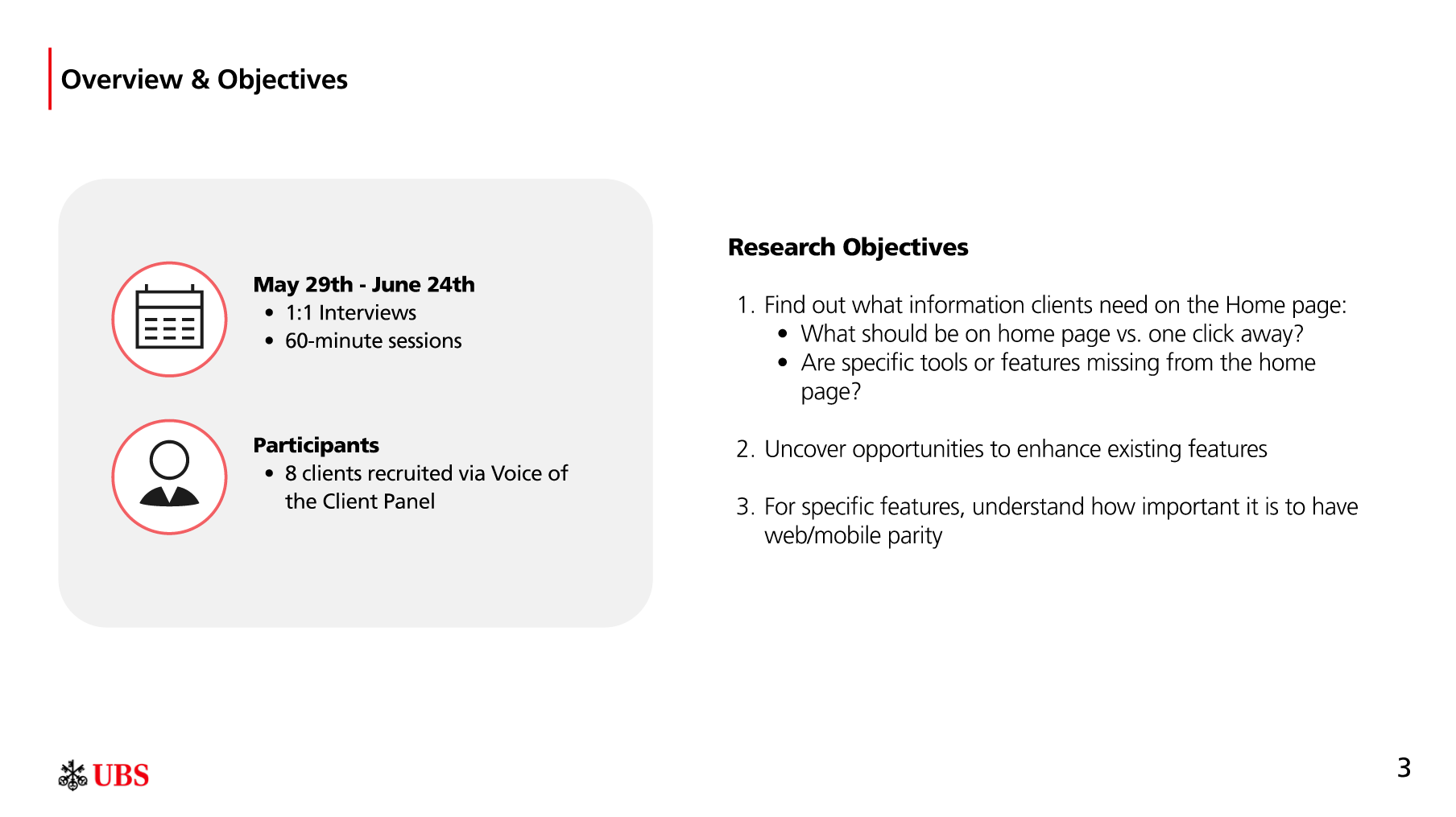
Objectives: I began my meeting with the product owners to align on what exactly their objectives were. They were pretty straight forward:
Discussion Guide:
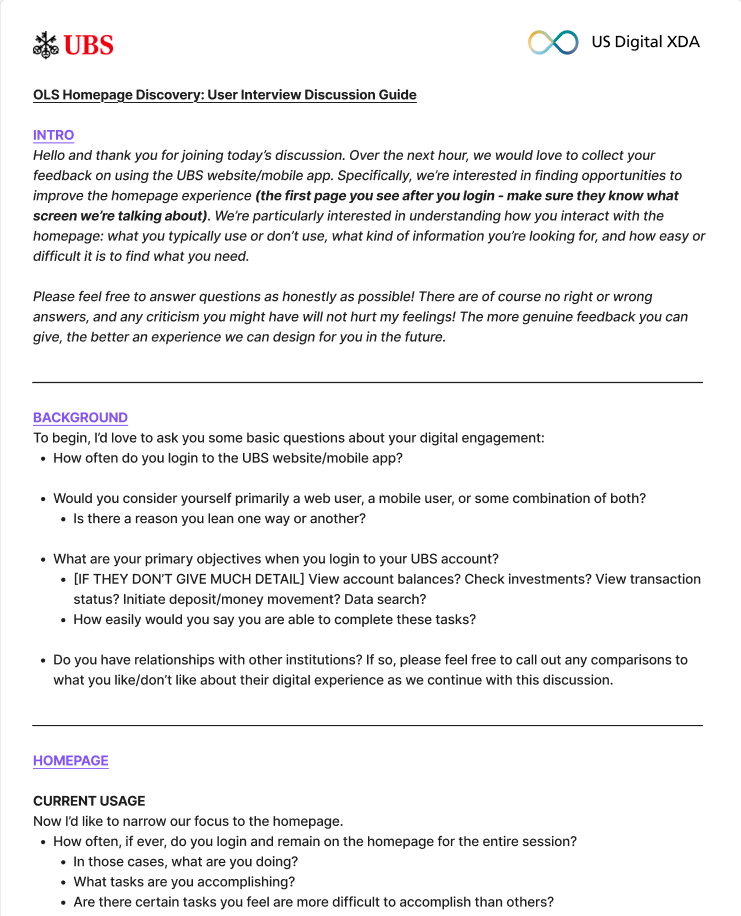
From here, I developed a discussion guide that would allow us to get answers to the above. The guide consisted of 2 parts:
An open-ended discovery conversation. For the first 15 minutes, I asked high-level questions on:
Client behavior - how often do you login, what are you usually trying to do, how does the homepage support / degrade your experience?
What’s missing - are there certain things you’d expect to be on the homepage but aren’t? How do you
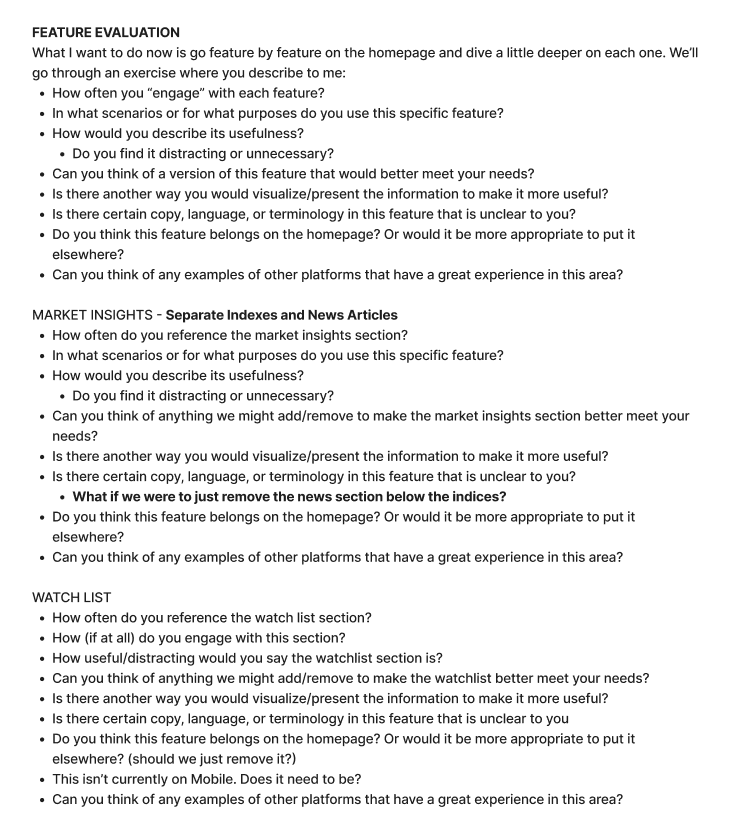
A feature evaluation. Feature by feature I asked clients a set of standardize questions, such as:
How often do you utilize this specific feature?
In what scenarios do you utilize this feature?
How well does this feature support your login tasks?
Are there certain data points, information, or functionality missing?
What would you change about this feature to enhance its usability?
Does this feature warrant being on the homepage?
User Interviews:
You can learn a lot about clients’ wants and needs if you actually sit down and listen to them. I began the conversations by asking clients what their current behaviors are and what their main objectives were when logging on to the website. Once I had my bearing, we began to deep dive on how the homepage could better support them in achieving those objectives. Feature by feature, clients told me how their ideal version would look and feel. What came out of the conversations was a prioritized set of opportunities for design updates that would create real, meaningful impact, based on the following client needs:
Performance:
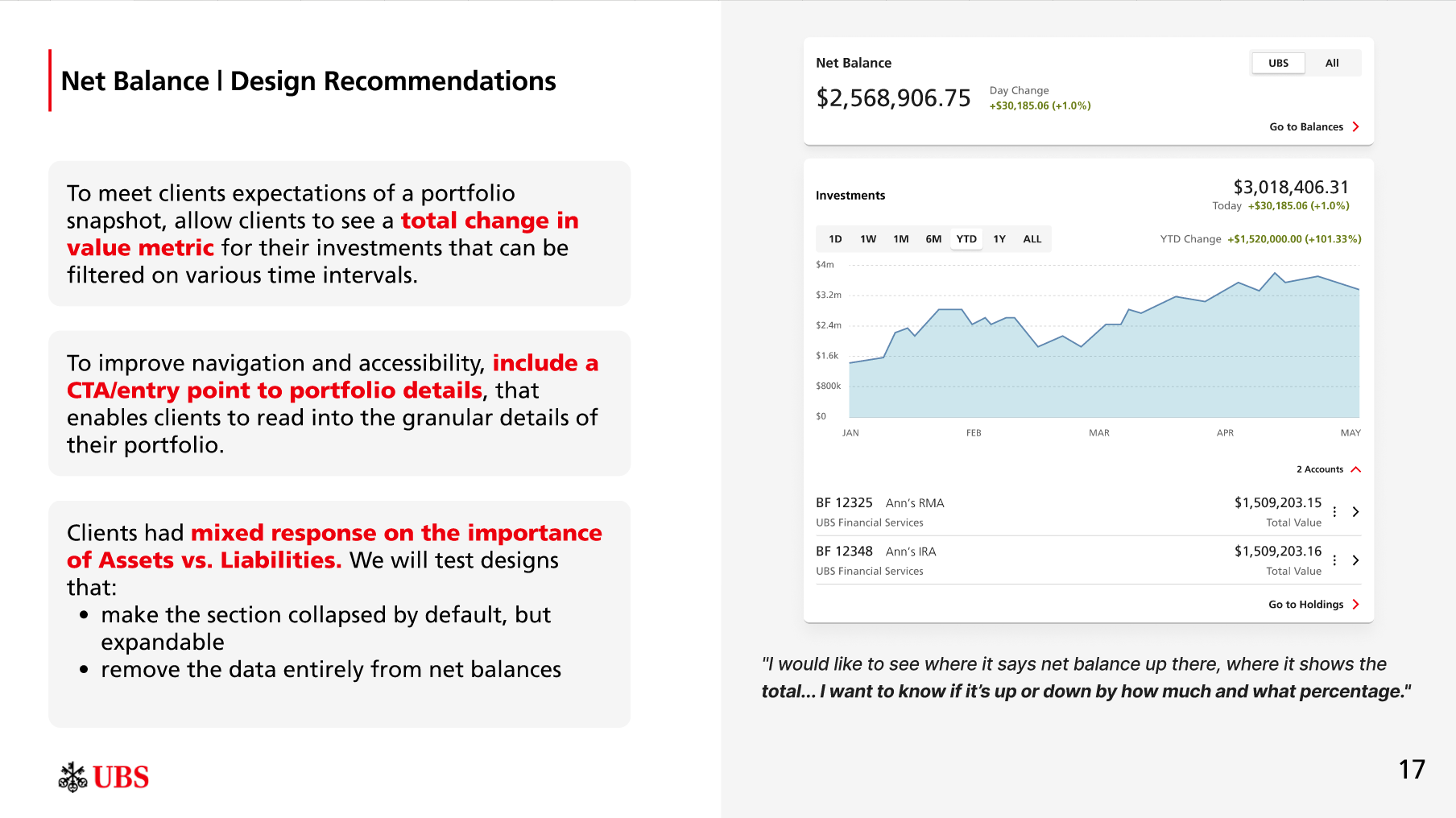
Clients expect to be able to access figures such as account value over time and percentage up/down at the aggregate level, from the homepage. We talk about trust as one of our key pillars, but we don’t trust clients can handle the daily ups and downs of their portfolio?
Personalization:
Giving users a degree of control in terms of what they see on the homepage would help them focus on what matters most to them. Some features are inherently going to be less useful to certain clients, and that’s fine. Let them drive.
Focus:
A jack of all trades is a master of none. Clients don’t need everything on the homepage. Features like the watchlist and market insights lack visibility, are underutilized, and have poor perceived value even when noticed. What if we just remove them?
Based off each the 3 themes above and direct client feedback during the feature evaluation, we developed a set of redesign opportunities for each of the core components on the homepage - Net Balance, Account List, Cash Tile, Recent Activity, Banking Products, Watch List, and Market Insights. We presented our opportunities to stakeholders in the following format:
Next Steps (in progress):
Our work isn’t done yet. After we presented the findings to our product owners, I collaborated with our lead designer to develop mockups for each of our 14 recommendations that we are currently testing with clients.
As of writing this (Friday, August 15th), we have a live client survey that will give us thousands of data points on our proposed concepts. Once our survey is complete, we’ll have a strong POV on what direction we should head in for each enhancement / new feature. We will then develop functional prototypes to run usability tests on.
What I learned from this project:
This project emphasized the importance of a few principles that define best practices for UX research and design, both product and process-specific:
On a homepage, less is more — trying to do too much on the homepage creates fatigue and undesired cognitive load, and reduces the likelihood that clients will use features towards the bottom of the screen
Customization drives relevance — allowing clients to control what they see on the homepage signals highly valued personalization
Performance tells the portfolio story — clients feel their snapshot (one of the common login journeys) is incomplete if we’re not showing them account value over time and basic portfolio performance details